
Hispanic American Economic Area. Western Civilization







 WhatsApp
Economic Integration in Hispanic America, MERCOSUR, Andean Community (Module)

Hispanic America Countries seek to integrate their economies. Several integration projects are underway: UNASUR, ALADI, ALBA, MERCOSUR, and the Andean Community.
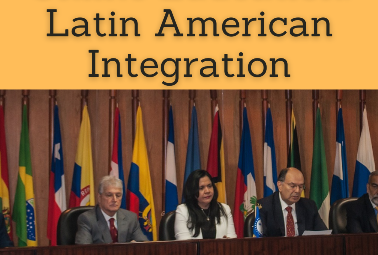
Latin America seeks its identity based on a common history (former colonies), Language (Spanish and Portuguese), Religious (Christianity), ethnic (although we should consider the existence of different ethnic groups).

Religious diversity and geopolitical tensions
- Introduction to the Hispanic American Economic Area of Western Civilization
- Economic Profile of Hispanic America Countries
- Latin American Economic Integration Processes (Western Civilization, American, Economic Organizations, Trade Agreements)
- Interactions with other civilizations.
- Latin American Integration Association (LAIA)
- Economic Integration in South America
- The case of Chile
- Andean Countries
- The case of Mexico
- Economic Integration in Central America
- Other Economic Institutions and Trade Agreements related to integration in Hispanic America (Iberian America)
- Relations between Latin America and Europe, Asia, the Arab Countries, Africa
Sample - Christianity in America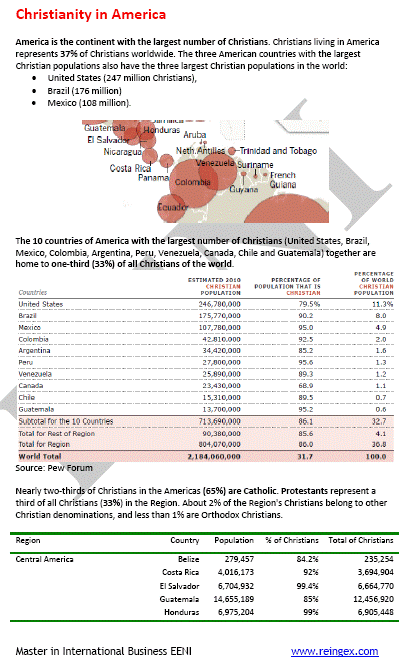

Religions and Global Business -
Religious diversity
The goals of the module “Hispanic American Economic Area” are the following:
- To define the characteristics of the Hispanic American Economic Area of Western Civilization
- To analyze the influence of Christianity on the Hispanic American Economic Area
- To learn about economic profile of Hispanic America Countries
- To analyze the businesspeople profile in the Hispanic American Economic Area
- To understand the economic integration process in Hispanic America (Western Civilization)
- To learn about economic relations with other civilizations (Sinic, Hindu, Islamic, African, Buddhist) and with other areas of Western Civilization (Europe, Caribbean, U.S.)
- To analyze the main Economic Organizations related to the Hispanic American Economic Area

Module “Hispanic American Economic Area (Western-Christian Civilization)” is included within the curriculum of the following academic programs at EENI Global Business School:
Masters: International Business, Religions & Business.

Doctorate: Ethics, Religions & Business, World Trade.

Why study “Christianity and Business”?.
Languages:  or
or  Civilización América Latina
  Civilizacion Amerique Latine
  Civilização Latino-Americana.
- Credits of the module “Hispanic American Economic Area”: 4

- Duration: 4 weeks
Download the Syllabus of the module “Hispanic American Economic Area” (PDF).
1- Introduction to the Hispanic American Economic Area of Western Civilization
- South American sub-continent
- Christianity in Hispanic America (Iberian America)
- Hispanic America Countries
- Hispanic American Economy
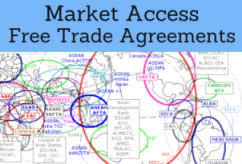
2- Processes of the Latin American Economic Integration of Western Civilization (Economic Organizations, Trade Agreements) and the interactions with other civilizations.
2.1- Latin American Integration Association (ALADI).

2.2- Integration in South America.

- Introduction to MERCOSUR
- Member countries of MERCOSUR: Argentina, Brazil, Paraguay, and Uruguay
- Incorporation of Bolivia (accession process) and Venezuela
- MERCOSUR Interactions with
- Christian Civilization
- European Economic Area: European Union-Mercosur
- Hispanic American Economic Area: Chile, Andean Community, Mexico, and Peru
- Hindu Civilization: India
- With Islamic Civilization / African Civilization: Egypt
- With African Civilization: Agreement with the Southern African Customs Union (Not in force)
- With Israel
- Africa-BRICS Cooperation (Brazil)
- Christian Civilization
2.3- The Case of Chile (40% of the Chilean Foreign Trade is made with Asia).
- Chilean integration and FTAs with Western Civilization
- Latin America: ALADI, MERCOSUR (associated), Andean Community (associated), Peru, Ecuador, Colombia, Mexico, Central America, and Panama. Pacific Alliance (Chile, Colombia, Mexico, and Peru)
- North America: United States and Canada
- Europe: European Union, European Free Trade Association (EFTA)
- FTA with Australia
- Agreement with Islamic Civilization: FTA with Turkey
- Agreements with Sinic-Buddhist Civilization: China, Japan, and South Korea
- Agreements with Hindu Civilization: India
- Inter-civilization Agreements:

2.4- Andean Countries.
- Andean Community
- Andean Countries: Bolivia, Colombia, Ecuador, and Peru
- Integration and Trade Agreements with:
- Christian Civilization - Latin America:
- Christian Civilization - North America:
- United States (FTA): United States-Colombia, United States-Peru Agreement
- Canada (FTA): Colombia-Canada, Peru-Canada Agreement
- Christian Civilization - European: Association Agreement with the European Union (EU-Colombia, Peru), Colombia-European Free Trade Association (EFTA) FTA and Peru-EFTA Agreement
- Hindu Civilization: India
- Orthodox Civilization: Russia
- Sinic - Buddhist Civilization: Andean Community-China. Peru has agreements with China, Singapore, and South Korea
- Peruvian inter-civilization Agreements: APEC and TPP

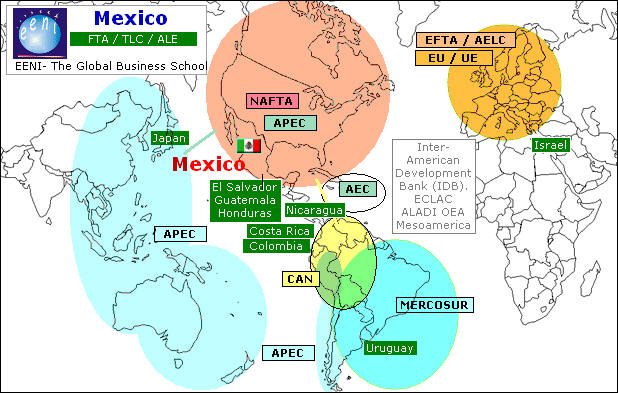
2.5- The case of Mexico: a Latin American country with the most FTA and a member of the USMCA/NAFTA 2.0.
- Mexican Market
- Mexican Agreements
- Mexican integration and trade agreements with Western Civilization:
- Latin America: ALADI, Northern Triangle, Colombia, Costa Rica, Nicaragua, Uruguay, Chile, MERCOSUR, Andean Community, Peru, and Ecuador
- North America: USMCA/NAFTA 2.0
- Europe: European Union, European Free Trade Association (EFTA)
- Mexican Agreements with Sinic Civilization - Buddhist: Japan
- Agreement with Israel
- Inter-civilization Agreements:
- APEC
- Comprehensive and Progressive Agreement for Trans-Pacific Partnership (CPTPP)

2.6- Central America.
- Economy of Central America
- Central American Common Market - Integrated with SICA -
- Central American Integration System
- Central American Countries: Belize, Costa Rica, El Salvador, Honduras, Guatemala, Nicaragua, and Panama. The Dominican Republic
- The case of Guyana and Suriname
- Central America Free Trade Agreements
- Agreements with Western Civilization
- Latin America:
FTA agreements with Panama, Central America and the Dominican Republic. Nicaragua and Costa Rica have a Free Trade Agreement with Mexico. Panama has a Trade Agreement with Chile. Andean Community-Panama
The Northern Triangle countries Agreements (El Salvador, Guatemala, and Honduras) with Mexico and Colombia - North America: CAFTA-DR agreement (United States-Central America-Dominican Republic), Honduras-Canada, Canada-Costa Rica, Panama-Canada, United States-Panama Agreement
- The Caribbean: Caribbean Community-Costa Rica Agreement
- Europe: Association Agreement with the European Union, EFTA-Central America
- Latin America:
FTA agreements with Panama, Central America and the Dominican Republic. Nicaragua and Costa Rica have a Free Trade Agreement with Mexico. Panama has a Trade Agreement with Chile. Andean Community-Panama
- Agreements with Sinic Civilization.
- Taiwan has trade agreements with Honduras and El Salvador, Guatemala, Nicaragua, and Panama
- China-Costa Rica Agreement
- Singapore-Panama Agreement
- Agreements with Western Civilization
Other Economic Institutions and Organizations related to integration in Hispanic America.
- Organization of American States (OAS)
- Community of Latin American and Caribbean States (CELAC)
- Inter-American Development Bank
- Economic Commission for Latin America (ECLAC)
- Latin American and Caribbean Economic System
- Union of South American Nations (UNASUR)
- Bolivarian Alliance for the Peoples of Our America (ALBA)
- Mesoamerica Project
- Association of Caribbean States
- CARICOM
Relationships of Latin America with Asia, the Muslim Countries, and Africa.
- FEALAC
- Summit of South American-Arab Countries
- Africa-South America Summit
Latin America differs from other areas of Western Civilization in several aspects: influence of the Amerindian religions, no influence of Protestant Reformation, the Hispanic America Countries were colonies rather than colonisers.
Christianity is the main religion of Latin America. Latin America has been eminently Catholic, but Protestantism is becoming increasingly important.
The Hispanic America Countries of the Pacific are increasingly turning to the Asia-Pacific region (Chile, Peru, and Mexico belong to APEC). Perhaps Mexico is an exception (member of the USMCA/NAFTA 2.0). Surely, Brazil is becoming the Central State.
Several Latin American civilizations had arisen in pre-Columbian times. Arnold Toynbee identified four pre-Columbian civilizations: the Andean civilization (the Universal State was the Inca Empire, and Inca religion -Viracocha-), Maya (Mayan religions, polytheistic), Mexican and Yucatan (absorbed by the Mexican), none has survived. Although it should also be considered Olmec civilization (Mexico).

(c) EENI Global Business School (1995-2025)
Top of this page
