Business in Argentina, Buenos Aires






 WhatsApp
Argentinian Economy. Exporter, cereals, wine (International Trade), Mendoza, Logistics

Argentina is a Frontier Market
- 1,000 foreign corporations are in Argentina, including 50% of the Fortune 100 firms
- Argentinian Automotive Industry is a key contributor to the manufacturing production and exports
- The Argentine Republic counts with an extensive competitive food and beverage industry
Buenos Aires is one of the largest cities in Hispanic America.

- Introduction to the Argentine Republic (South America)
- Argentinian Economy
- Economic Profile of Argentinian provinces
- International Trade of Argentina
- Investment in Argentina
- Case Study:
- Argentinian Automotive Industry
- Biotechnology
- Software and information technology services
- Creative industries
- Transport and Logistics
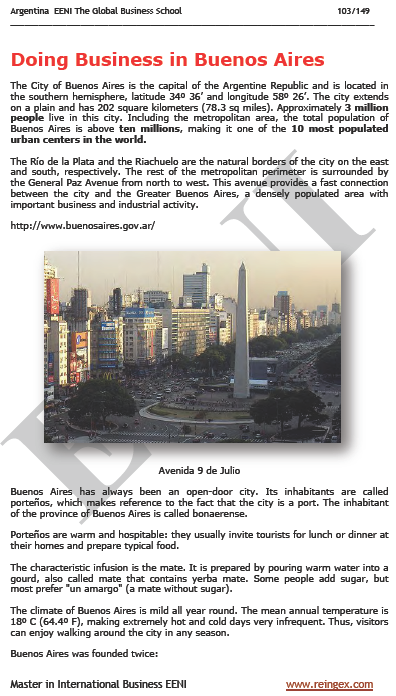
- Doing Business in Buenos Aires
- Case Study:
- Audiovisual industry in Buenos Aires
- Arcor Group
- Access to Argentinian Market
- Business Plan for Argentina
The educational aims of the Subject “Foreign Trade, Logistics and Business in Argentina” are:
- To analyze Argentinian Economy, Logistics and Global Trade
- To conduct research on business opportunities in Argentina
- To explore Argentinian trade relations with the student's country
- To know Argentinian Trade Agreements
- To examine the profile of Argentinian companies
- To develop a business plan for Argentinian Market


The Subject “Foreign Trade, Logistics and Business in Argentina” is included within the curriculum of the following academic programs at EENI Global Business School:
Masters: International Business, Foreign Trade.


Languages:  or
or  Argentina
  Argentina
  Argentine.
- Subject Credits “Doing Business in Argentina”: 2

International Trade, Logistics and Business in Argentina.
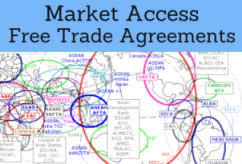
Preferential Access and Trade Agreements of Argentina.
- Argentina and the Hispanic American Economic Area
- MERCOSUR
- Latin American Integration Association (ALADI)
- Union of South American Nations (UNASUR)
- Latin American and Caribbean Economic System
- Argentina-Mexico Economic Complementation Agreement
- Global System of Trade Preferences
- Andean Community (associate member)
- SICA (observer country)
- World Trade Organization (WTO)
- Agreement on Trade in Services (GATS)
- Agreement on Sanitary Measures
- Agreement on Technical Barriers to Trade
- Agreement on Preshipment Inspection
- Agreement on Safeguards
- Trade Facilitation Agreement
- World Customs Organization (WCO)
- Kyoto Convention
- International Road Transport Union (IRU)
- TIR Convention
- Guidelines on Safe Load Securing for Road Transport
- Inter-American Development Bank
- Organization of American States (OAS)
- Economic Commission for Latin America (ECLAC)
- East Asia-Latin America Cooperation
- Summit South American-Arab Countries
- Africa-South America Summit
- CELAC

Global Economic Organizations (Argentina)
- United Nations
- World Bank
- International Monetary Fund
- Organization for Economic Cooperation and Development (OECD)
- African Development Bank
- CPLP (observer country)
- Borders of the Argentine Republic: Bolivia, Paraguay, Brazil, Chile, and Uruguay
- Argentinian capital: Buenos Aires
- Argentinian official language: Spanish
- Argentina has a population of 42 million people
- Argentina is the eighth largest country in the World
- Currency of Argentina: Argentinian Peso
- Abolition of Slavery in Argentina 1853
- African Diaspora in Argentina: 0.1% of Argentinian population
- Independence of Argentina from Spain: 1816, recognized in 1857
Main religion in Argentina: Christianity (Catholicism: 38 million, Maronites: 750,000).
Argentina belongs to the Hispanic American Economic Area of Western Civilization.
- Including its metropolitan area (Greater Buenos Aires), Buenos Aires has 13 million people, one of the ninth most populated urban conglomerates in the World
- Buenos Aires is the thirteenth urban centre with the largest revenue in USD in the World, ahead of Hong Kong, Miami or São Paulo, and its growth forecasts are excellent
- Buenos Aires is home to big Argentinian companies
The main economic sectors of Buenos Aires are:
- Creative industries
- Software
- Pharmaceutical industry
Argentinian Economy.
- The Automotive sector represented 2.5% of the Argentinian GDP (including the automotive parts manufacturing), 8.5% of the industrial output and 10% of total exports
- Ten car makers in Argentina: Fiat, Ford, General Motors, Iveco, Mercedes-Benz, PSA Peugeot-Citroën, Renault, Scania, Toyota, and Volkswagen
- Software and computer services industry in Argentina has 40,000 workers in near 1,000 companies
- Creative industries are principally concentrated in Buenos Aires
- Other big cities in Argentina, Cordoba, Mendoza or Rosario, are also developing the creative industries sector
- Significant accumulation of reserves
- A fixed monetary policy
- A competitive exchange rate
- Argentina has significant natural resources
- Argentina is a member of MERCOSUR
International Trade and Business in Argentina
Argentinian Emerging Sectors:
- Biofuel
- Software
- TV
- New technologies
International Trade of Argentina.
- Argentinian exports decreased by 12% (cereals, fuel, energy, industrial manufacturing, slowdown in Brazil) and imports decreased by 11.4%
- Services export sector registered a record-high volume of 12 billion dollars (one of the highest levels in Hispanic America)
- The largest Argentinian trading partners are Brazil, China, Chile, the United States, and Germany
- Records of Foreign Direct Investment in twenty-five years
Argentina is a member of MERCOSUR (Argentina, Brazil, Paraguay, and Uruguay), having access to a widespread market with 295 million people and the chance of exporting to and importing from MERCOSUR economies without having to pay customs duties. Since the creation of MERCOSUR, Foreign Trade between Argentina and the other members of MERCOSUR went up by 500%
(c) EENI Global Business School (1995-2025)
Top of this page
