Catholicism, Ethics, Business. Catholic Church





 WhatsApp
Ethical Principles of Catholics (Christianity) influence on business
50% of all Christendom is Catholic, 37% Protestant, and 12% Orthodoxy. The other Christian traditions (Mormons, Jehovah Witnesses) represent 1% of all Christendom.
Roman Catholicism, based in Rome, is the majority in Central and Southern Europe, Ireland, and South America.
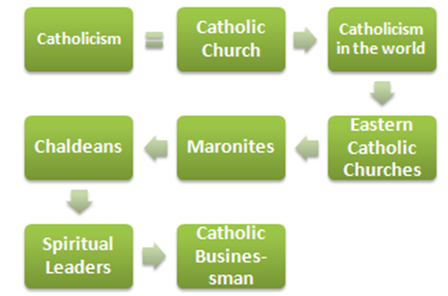
From the organizational point of view, if there is anything that can define Catholicism is the Catholic Church and the figure of Pope.
The Subject “Catholicism, Ethics and Business” consists of six parts:
1- Introduction to Catholicism.
- Introduction to the Catholic Church (Christianity)
- Pope of Rome
- Doctrine of Papal Infallibility
- Holy Eucharist (Catholic Sacrament)
- Eastern Catholic Churches
- Case Study: Caritas
2- Catholicism in the World
3- Catholicism and Western Civilization.
- European Economic Area
- American Economic Area (Hispanic American, North American, Caribbean)
- Oceania
4- Catholic Spiritual Leaders.
5- Catholic Businesspeople
- Amancio Ortega (Spain)
- Antonio Moraes and John Robert Marinho (Brazil)
- Luis Carlos Sarmiento Angulo (Colombia)
- Thomas Monaghan
- Carlos Slim (Mexico)
- Nadhmi Shakir Auchi (Iraq)
- Isabel dos Santos (Angola)
6- Catholic intellectuals and personalities:
- Joseph Ki-Zerbo
- Théophile Obenga
- Elikia M'Bokolo
- Victor Schoelcher
- Marcus Garvey
- Leopold Sédar Senghor
Sample: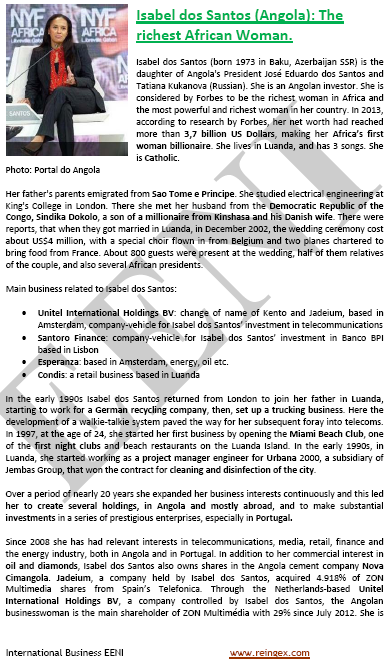
Religions and Global Business -
Religious diversity
The purposes of the subject “Catholicism, Ethics and Business” are the following.
- To understand the fundamentals of Catholicism
- To learn about fundamental role of the Catholic Church and Pope of Rome in Catholicism
- To understand the ethical principles of Catholicism
- To learn about the influence of Catholicism on business
- To analyze the figures of Catholic businesspeople and personalities
- To learn about distribution of Catholicism in the World
- To analyze the role of Catholicism on Western Civilization

The Subject “Catholicism, Ethics and Business” is included within the curriculum of the following academic programs at EENI Global Business School:
Master: Religions & International Business, International Business, Business in Africa.
Doctorate: Ethics, Religion & Business, African Business.
Languages:  or
or
 Catolicismo
  Catholicisme.
Christianity is the most “globalized” religion (in Greek, Catholic means “universal”), with about 2,400 million followers worldwide, followed by Islam with 1,977 million, and Hinduism.
Namely, one-third of humanity is Christian. About half of Christians are Catholics (1,200 million).
Number of Catholics (million people):
- America: 515
- Europe: 236
- Africa: 173
- Asia: 123
- Oceania: 7
Jesus came to the earth to show the way of salvation. Therefore, these teachings taught twenty centuries ago, should be available to future generations; this is possible through the Bible. However, it will be necessary to interpret the Bible. Moreover, the only entity that can interpret the teachings of the Bible is the Catholic Church.
This concept of the Church as the sole interpretive authority is fundamental to understand Catholicism.
Papal Infallibility.
Derived from the principle of Papal Infallibility, there is the dogma of Papal Infallibility. The Pope of Rome as the successor of St. Peter, and the highest authority of Catholicism, when pronounced in a public way on a topic related to faith or morals (“Solemn Pontifical definition”), God, through the Holy Spirit protects him from any error.
In matters of faith, the Pope cannot be wrong.
- Yoga of the Threefold Faith of the Bhagavad Gita
This “Papal definition” is not debatable. In any case, today, on very few occasions the Pope uses this privilege and is almost always done by a consensus. A Catholic must, therefore, accept this principle.
The Catholic Church maintains the exclusivity of Jesus teachings and defines the way in which a Catholic must behave, the Church teaches to Catholic how he should live to follow the teachings of Jesus correctly.
The Church, as God earthly representative, is the institution that monopolizes the teachings through the Sacraments. Catholic, Orthodoxy, and Copts share the same seven Sacraments.
The main Catholic Sacrament is the Holy Eucharist, Mass. For a Catholic, the Mass symbolically represents the reconstruction of the Last Supper of Christ, in which he offered bread and wine to his disciples.
A curious fact about Catholicism is that its highest authority, the Pope of Rome, is also the Head of State. It is the only church in the World that also has a country: The State of the Vatican City, the smallest independent state in the world, both in population (800 people) and size. No other religion has a “Central State.”
(c) EENI Global Business School (1995-2025)
Top of this page
