
Trade Facilitation Programs (WTO)







 WhatsApp
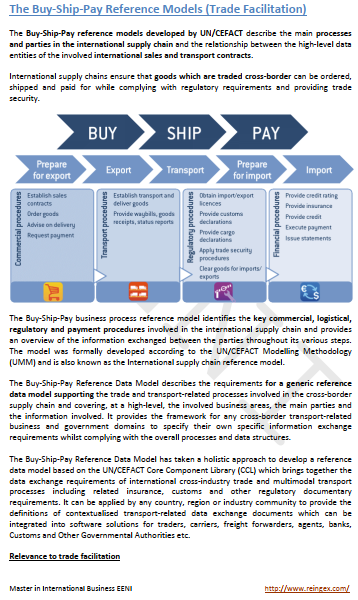
Global Supply Chain and Trade Facilitation. Buy-Send-Pay Model
In a highly globalized and competitive economy, enterprises, governments and trade blocs seek to implement measures that simplify exports and imports, that is, measures to facilitate Foreign Trade.
These measures should facilitate attraction of Foreign Direct Investment, competitiveness of all agents in Foreign Trade chain and integration of markets.
- Introduction to Trade Facilitation Programs
- WTO Trade Facilitation Agreement
- Potential Gains from Trade Facilitation
- The pillars of Trade Facilitation (transparency, simplification, harmonization and standardization)
- Global supply chain and Trade Facilitation
- Buy-Send-Pay Model (CEFACT / UN)
- Action Domains of Trade Facilitation (purchases, transport, customs, payments)
- Reducing Trade Costs for Least Developed Countries
- United Nations Trade Facilitation Implementation Guide
- International Transport and Trade Facilitation: CMR Convention, CIM Convention, Electronic Air Waybill (e-AWB), Electronic FIATA Bill of Lading (Maritime), TIR Convention, Documents of the FIATA, International Chamber of Shipping, International Road Transport Union (IRU), International Union of Railways (UIC), International Civil Aviation Organization (ICAO. Chicago Convention)...
- Port Administration and Trade Facilitation
- Transport security and Trade Facilitation
- International Ship and Port Facility Security Code (ISPSC) of the International Maritime Organization (IMO)
- Convention to facilitate international maritime traffic (FAL)
- Convention on Facilitation of International Maritime Traffic (FAL)
- Electronic commerce applied to facilitation of maritime transport
-
Customs and Border Crossings Administration.
- Dispatch of Cross-Border Trade
- The Kyoto Convention (Containers) of WCO
- Convention Harmonization of Frontier Controls of Goods
- Security of Supply Chain and Trade Facilitation
- SAFE Framework of Standards to Secure and Facilitate Global Trade of WCO. Authorized Economic Operator (AEO)
- Payment and Trade Facilitation (Buy-Send-Pay Model).
- Electronic Payments and Invoices
- Supply Chain Finance Instruments and Trade Facilitation (Letters of Credit, Guarantees, Collections, Factoring)
- Electronic Commerce Solutions
- Case Study:
- Single Window Implementation in Mozambique
- Ghana National Single Window Programme – A Phased
- Business Process Analysis in Cambodia
- Customs modernization in Jordan
- Interagency Collaboration for SW Implementation: Thailand's Experience
- Trade Facilitation and Logistics in Ukraine (IWG) as the basis for a national Trade Facilitation committee
Sample - Trade Facilitation:
The educational aims of the Subject «Trade Facilitation» are the following:
- Understand the fundamentals and domains (purchases, transport, customs, payments) of Trade Facilitation programs
- Learn about WTO Trade Facilitation Agreement
- Analyze the impact of Trade Facilitation programs on the global supply chain and related programs of major institutions
- Analyze the Buy-Send-Pay Model (CEFACT / UN)

The Subject «Trade Facilitation» is included within the curriculum of the following academic programs at EENI Global Business School:
Logistics Courses: International Transport, Maritime Transport, Multimodal, Road, Rail, Transport and Logistics in Africa.
Masters: International Business, Foreign Trade, International Transport, Transport and Logistics in Africa.

Languages:  or
or  Facilitation des échanges
  Facilitación del Comercio
  Facilitação do Comércio.
Area of Knowledge: Foreign Trade.
- International Maritime Transport Facilitation of International Maritime Organization (IMO)
- Electronic commerce applied to maritime transport facilitation
- International Road Transport Facilitation of International Road Transport Organization (IRU)
- Trade Negotiations Among Developing Countries
- Global System of Trade Preferences
FIATA transport documents:
Sample: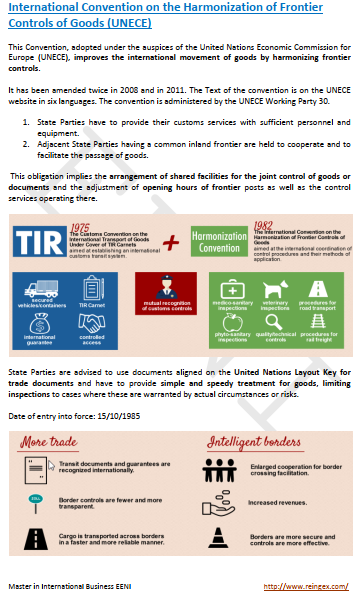
In recent years, significant progress has been made in Trade Facilitation: reduction of quota system and Tariffs. However, there is still a lack of transparency in many regulations, excessively bureaucratic customs clearance processes (slow and expensive), disproportionate documentary requirements...
The World Trade Organization (WTO) has included Trade Facilitation in multilateral trade negotiations.
Virtually all free trade agreements include chapters on Foreign Trade facilitation.
The main objective of Trade Facilitation programs implemented by governments is to improve cross-border trade (time, costs, security).
Many institutions at the global and regional level have developed trade facilitation programs: UN, Conference on Trade and Development (UNCTAD), World Customs Organization, IATA, UNECE (Economic Commission for Europe) and IMO.
Sources: United Nations Economic Commission for Europe and UN Commission on International Trade Law (UNCITRAL).
WTO agreements related to Trade Facilitation:
- Agreement on Customs Valuation
- Preshipment Inspection
- Agreement on Preshipment Inspection
- Agreement on Rules of Origin
See also:
(c) EENI Global Business School (1995-2025)
Top of this page
