
Sanitary and Phytosanitary Measures (SPS WTO)







 WhatsApp
Foreign Trade: Non-tariff Sanitary and Phytosanitary Measures (SPS)
In Foreign Trade, the Sanitary and Phytosanitary Measures (SPS) are all non-tariff technical measures aimed at protection of people, animals, forests and plant life.
These Sanitary and Phytosanitary Measures seek to protect against the risks of contaminating products, toxins or additives in food products.
- Introduction to Sanitary and Phytosanitary technical measures (SPS) in International Trade
- Objectives of non-tariff Sanitary and Phytosanitary Measures
- Analysis of the main Sanitary and Phytosanitary Measures
- Conformity assessment related to Sanitary and Phytosanitary Measures
- Agreement on the Application of Sanitary and Phytosanitary Measures
Sample - Sanitary and Phytosanitary Measures (SPS):
The educational aims of the Subject “Sanitary and Phytosanitary Measures (SPS)” are the following:
- To know how to identify and distinguish non-tariff sanitary and phytosanitary (SPS) measures in Foreign Trade
- To know how to act against a sanitary or phytosanitary measure (SPS) implanted by a country
- To evaluate the possible impact they may have on product exports

The Subject “Sanitary and Phytosanitary Measures (SPS)” is included within the curriculum of the following academic programs at EENI Global Business School:
Masters: International Business, Foreign Trade, International Transport.

Languages 
 Medidas sanitarias y fitosanitarias
 Mesures sanitaires et phytosanitaires
  Medidas sanitárias e fitossanitárias.
Sanitary and Phytosanitary Measures (SPS).
- They also seek to protect lives of people from possible diseases related to the intake of animals or vegetables
- They can also protect the spread of pests or biodiversity
The Sanitary and Phytosanitary Measures are controlled by the customs of the country of destination
The main Sanitary and Phytosanitary Measures (SPS) are the following:
- Prohibitions or
Restrictions
of imports for sanitary and phytosanitary reasons
- Temporary geographic prohibitions for sanitary and phytosanitary reasons
- Geographical restrictions on eligibility
- Systems approach (applies two or more independent sanitary and phytosanitary measures to a specific product)
- Special authorization requirement for sanitary and phytosanitary reasons
- Registration requirements for importers
- Other prohibitions/restrictions of imports for sanitary and phytosanitary reasons
- Tolerance limits for residues and restricted use of substances
- Residue tolerance limits or contamination by certain substances (not microbiological). Maximum residue limits (MRL)
- Restricted use of certain substances in food and feed
- Labeling, marking and packaging requirements
- Labeling requirements
- Marking requirements on packaging (food safety)
- Packing and packaging requirements
- Hygienic requirements (final product or productive process).
- Microbiological criteria of the final product
- Hygienic practices during production
- Other Hygienic requirements
- Treatment for elimination of plant and animal pests and disease-causing organisms in the final product
- Cold/heat treatment
- Irradiation
- Fumigation
- Other treatments
- Other requirements on production or post-production processes
- Plant-growth processes
- Animal-raising or catching processes
- Food and feed processing
- Storage and transport conditions
- Other requirements
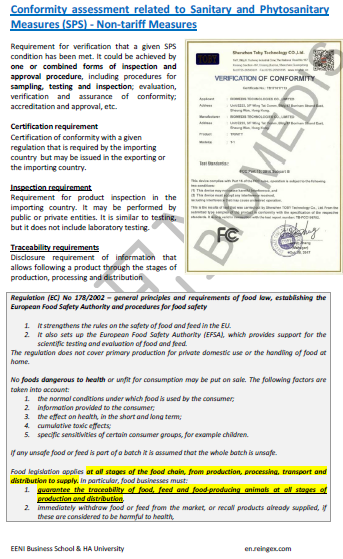
- Conformity assessment related to Sanitary and Phytosanitary measures
- Product registration requirements
- Test or compliance requirement
- Requirement of certification in accordance with a precise standard
- Inspection requirement in the country of the Importer
- Traceability requirements (production, processing, distribution)
- Origin of materials or parts
- Historical of the elaboration process
- distribution and location of products after delivery
- Other traceability requirements
- Quarantine requirements
Non-tariff measures in Foreign Trade (Customs, Technical barriers to Foreign Trade, Pre-shipment Inspection, Anti-dumping Measures and safeguards, Import licenses and quotas).
Trade Facilitation - Trade Facilitation Agreement - Kyoto Convention (Containers) - Convention Harmonization of Frontier Controls of Goods.
(c) EENI Global Business School (1995-2025)
Top of this page
