
Agreement on Sanitary and Phytosanitary Measures (SPS)








 WhatsApp
SPS Agreement on the Application of Sanitary and Phytosanitary Measures (WTO)
The Agreement on the Application of Sanitary and Phytosanitary Measures (SPS Agreement) of the World Trade Organization (WTO) establishes how the governments can apply the Sanitary and Phytosanitary Measures (international standards, guidelines and recommendations).
The Agreement on the Application of Sanitary and Phytosanitary Measures complements the Agreement on Technical Barriers to Trade.
- Introduction to the Agreement on the Application of Sanitary and Phytosanitary Measures (SPS Agreement) of WTO
- In-depth analysis of the SPS Agreement
- SPS Information Management System (WTO)
- SPS & TBT notification alert system
- Sanitary and Phytosanitary measures in the European Union
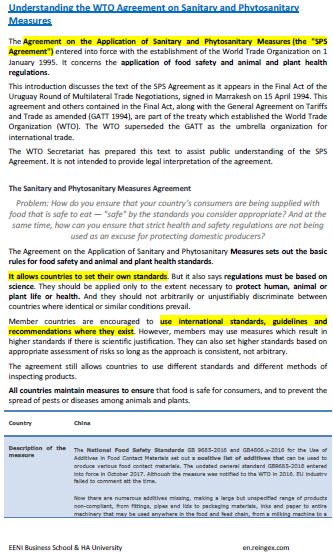
Sample - Agreement on the Application of Sanitary and Phytosanitary Measures (SPS):
The educational aims of the Subject “Agreement on the Application of Sanitary and Phytosanitary Measures (SPS)” are the following:
- To learn about concepts of Sanitary and Phytosanitary Measures in International Trade
- To understand the pillars of WTO Agreement on the Application of Sanitary Measures
- In-depth analysis of the Agreement on the Application of Sanitary and Phytosanitary Measures (SPS) to evaluate the implications for an exporting company

The Subject “Agreement on the Application of Sanitary and Phytosanitary Measures (SPS)” is included within the curriculum of the following academic programs at EENI Global Business School:
Masters: International Business, Foreign Trade.


Learning materials in

 Acuerdo Medidas Sanitarias y Fitosanitarias
  Accord des mesures sanitaires et phytosanitaires
  Acordo Medidas Sanitárias e Fitossanitárias.
Area of Knowledge: Foreign Trade. Technical Barriers to Trade.
Trade Facilitation - Trade Facilitation Agreement - Kyoto Convention (Containers) - Convention Harmonization of Frontier Controls of Goods.
These Sanitary and Phytosanitary Measures may be related to:
- Food safety
- Animal health
- Preservation of vegetables
The Agreement on the Application of Sanitary and Phytosanitary Measures allows governments to implement their own standards provided that they are based on internationally recognized scientific principles and that they comply with the three previous points.
The principle of non-discrimination is applied in the Agreement on the Application of Sanitary and Phytosanitary Measures (SPS Agreement).
The SPS Agreement also allows the establishment of standards and methods related to the inspection, control and approval of products by Governments.
The Subjects included in the Agreement on the Application of Sanitary and Phytosanitary Measures:
- Basic rights and obligations
- Harmonization
- Equivalence
- Risk assessment
- Determination of the appropriate level of sanitary or phytosanitary protection
- Pest- or Disease-Free Areas
- Control, inspection and approval procedures
- Special and differential treatment
- Dispute settlement
- Transparency of Sanitary and Phytosanitary Regulations
The Agreement on the Application of Sanitary and Phytosanitary Measures (SPS Agreement) has been in force since 1995
Non-tariff measures:
(c) EENI Global Business School (1995-2025)
Top of this page
