
Pan-European Corridor IX (Finland Russia Greece)







 WhatsApp
Pan-European Corridor IX (Russia, Finland, Lithuania, Belarus, Ukraine, Moldova, Romania, Bulgaria, Greece)
Trans-European Transport Corridors
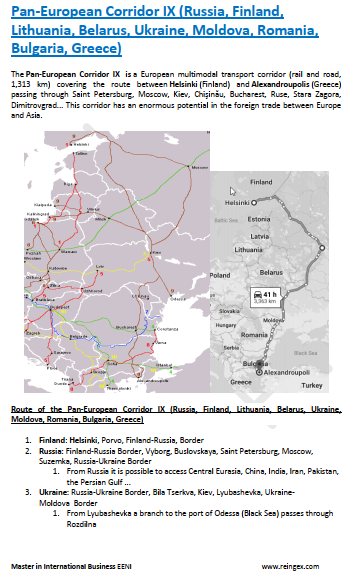
The Pan-European Corridor IX is a European Multimodal Transport corridor (rail and road, 1,313 km) covering the route between Helsinki (Finland) and Alexandroupolis (Greece) passing through Saint Petersburg, Moscow, Kiev, Chişinău, Bucharest, Ruse, Stara Zagora, Dimitrovgrad... This corridor has an enormous potential in Foreign Trade between Europe and Asia.
- Introduction to the Pan-European Corridor IX (Finland, Russia, Greece)
- Member countries of the Corridor: Russia, Finland, Lithuania, Belarus, Ukraine, Moldova, Romania, Bulgaria, Greece
- Main features of the Pan-European Corridor IX (Russia, Finland, Lithuania, Belarus, Ukraine, Moldova, Romania, Bulgaria, Greece)
- Access to:
- Trans-European Transport Corridors
- Pan-European Transport Corridor II (Russia-Germany)
- Europe-Caucasus-Asia Logistics Corridor
- Trans-Siberian Railway (Russia, North Korea)
- International North-South Logistics Corridor
- North Sea-Baltic Corridor (Finland, Belgium)
- China-Russia Logistics Corridor
- Baltic-Adriatic Corridor (Poland, Slovenia)
- Corridor of the Ashgabat Agreement
- Countries in the influence area of the Pan-European Corridor IX: Estonia, Latvia, Poland, Hungary, Serbia, Macedonia, and Turkey
- The corridor and the New Silk Route
Pan-European Transport Corridor IX (Russia, Finland, Lithuania, Belarus, Ukraine, Moldova, Romania, Bulgaria, Greece)

The Subject “Pan-European Corridor IX (Russia, Finland, Lithuania, Belarus, Ukraine, Moldova, Romania, Bulgaria, Greece)” is included within the curriculum of the following academic programs at EENI Global Business School:
Logistics Courses: Road Transport, Railway, Multimodal.
Certificate in International Transport
Masters: International Transport International Business.

Languages:  .
Summary in
.
Summary in  Corredor Paneuropeo
IX
Corredor Paneuropeo
IX
 Corridor paneuropéen IX
  Corredor Pan-Europeu IX.
Route of the Pan-European Corridor IX (Russia, Finland, Lithuania, Belarus, Ukraine, Moldova, Romania, Bulgaria, Greece)
- Finland: Helsinki, Porvo, Finland-Russia, Border
- Russia: Finland-Russia Border, Vyborg, Buslovskaya, Saint Petersburg, Moscow, Suzemka, Russia-Ukraine
Border
- From Russia it is possible to access Central Eurasia, China, India, Iran, Pakistan, the Persian Gulf..
- Ukraine: Russia-Ukraine Border, Bila Tserkva, Kiev,
Lyubashevka, Ukraine-Moldova Border
- From Lyubashevka a branch to the port of Odessa (Black Sea) passes through Rozdilna
- Moldova: Ukraine-Moldova Border, Dubasari, Chisinau, Leova, Moldova-Romania Border
- Romania: Moldova-Romania Border, Bucharest, Romania-Bulgaria Border
- Bulgaria: Romania-Bulgaria Border, Sophia, Bulgaria-Greece Border
- Greece: Bulgaria-Greece Border, Alexandroupolis
The Pan-European Corridor IX has two branches in the northern part:
- Branch 1: Klaipeda, Vilnius (Lithuania), Minsk, Gomel (Belarus)
- Branch 2: Kaliningrad (Russia), Vilnius (Lithuania), Minsk, Gomel (Belarus)
Finland, Lithuania, Romania, Bulgaria and Greece are members of the European Union (free movement of goods).
Countries in the influence area of the Corridor: Estonia, Latvia, Poland, Hungary, Serbia, Macedonia and Turkey.
The Pan-European Corridor IX (Russia, Finland, Lithuania, Belarus, Ukraine, Moldova, Romania, Bulgaria, Greece) connects with the New Silk Route.
Regional economic communities related to the Pan-European Corridor IX (Russia, Finland, Lithuania, Belarus, Ukraine, Moldova, Romania, Bulgaria, Greece).
- Eurasian Economic Union: Armenia, Belarus, Kazakhstan, Kyrgyzstan and Russia
- Commonwealth of Independent States: Armenia, Azerbaijan, Belarus, Kazakhstan, Kyrgyzstan, Moldova, Russia, Ukraine, Tajikistan, Turkmenistan and Uzbekistan
- Organization for Cooperation between Railways (OSJD): Azerbaijan, Albania, Afghanistan, Belarus, Bulgaria, Hungary, Vietnam, Georgia, Iran, Kazakhstan, China, North Korea, South Korea, Cuba, Kyrgyzstan, Latvia, Lithuania, Moldova, Mongolia, Poland, Russia, Romania, Slovakia, Tajikistan, Turkmenistan, Uzbekistan, Ukraine, Czech Republic and Estonia
- OSCE: Albania, Andorra, Armenia, Bosnia and Herzegovina, Belarus, Georgia, Holy See, Iceland, Liechtenstein, Macedonia, Monaco, Moldova, Montenegro, Norway, Russia, Serbia, Switzerland, San Marino, Turkey, Ukraine
- Black Sea Cooperation: Albania, Armenia, Azerbaijan, Bulgaria, Georgia, Greece, Moldova, Romania, Russia, Turkey and Belarus
- Organization for Democracy and Economic Development (GUAM): Azerbaijan, Georgia, Moldova and Ukraine
- Regional Cooperation Council: Bulgaria, Finland, Greece, Moldova, Romania
- Black Sea Synergy: Armenia, Azerbaijan, Georgia, Moldova, Russia, Turkey and Ukraine
- Russia is a member of:
- European Union-Russia
- APEC
- Shanghai Cooperation Organization
- Africa-BRICS Countries Cooperation
- Lithuania, Finland and Russia are a members of the Council of the Baltic Sea States (Belarus and Ukraine are observers)
- Russia and Belarus has the Union State
- Belarus, Moldova, Romania and Ukraine are a members of the Commonwealth of Independent States
- Belarus, Moldova and Ukraine are a members of EU Eastern Partnership (Neighbourhood Policy)
Related Trade Agreements
- Russia
- Trade Agreements of Russia: ASEAN, the EU, Andean Community, Armenia, Belarus, Azerbaijan, Georgia, Kyrgyzstan, Serbia, Moldova, Ukraine and New Zeeland
- Free Trade Agreement between Russia, Belarus and Kazakhstan
- Customs Union Russia-Vietnam
- Russia has a Trade Agreement with Cameroon
- Belarus
- Russia-Belarus Agreement
- Belarus-Ukraine Agreement
- Free trade agreement between Russia, Belarus and Kazakhstan
- Moldova
- Central European Free Trade Agreement (CEFTA)
- European Union-Moldova Agreement
- Ukraine
- Ukraine-EU Agreement
- EFTA-Ukraine Agreement
Main European institutions related to the corridor
- Economic Commission for Europe (UNECE)
- European Union Institutions
- European Economic and Social Committee
- European Investment Bank
- European External Action Service
The main Religions of the region of the Pan-European Corridor IX are:
The Pan-European Corridor IX belongs to:
Corridors related to the Silk Route
- Bangladesh-Myanmar Logistics Corridor
- Asia-Africa Logistics Corridor
- Almaty-Bishkek Logistics Corridor
- Afghanistan-Turkey Logistics Corridor
- China-Central-Western-Asia Logistics Corridor
- Kyrgyzstan-Iran Logistics Corridor
- Islamabad-Istanbul Logistics Corridor
- China-Pakistan Logistics Corridor
- Trans-Caspian Logistics Corridor
- Nanning-Singapore Logistics Corridor
- India-Afghanistan Logistics Corridor
(c) EENI Global Business School (1995-2025)
Top of this page
