Business in Lithuania, Vilnius, Port of Klaipeda







 WhatsApp
Lithuanian Foreign Trade, Logistics. Business in Vilnius (Lithuania, Baltic Tiger)
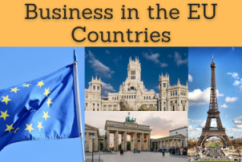
The Republic of Lithuania is one of EU countries with the largest economic growth
Lithuania, Estonia and Latvia are the so-called Baltic Tigers
Lithuania is a developed country (IMF)

- Introduction to the Republic of Lithuania (EU)
- Lithuanian Economy
- Doing Business in Vilnius
- Lithuanian International Trade
- Port of Klaipeda
- Investment in Lithuania
- Access to the Lithuanian Market
- Business Plan for Lithuania
Sample: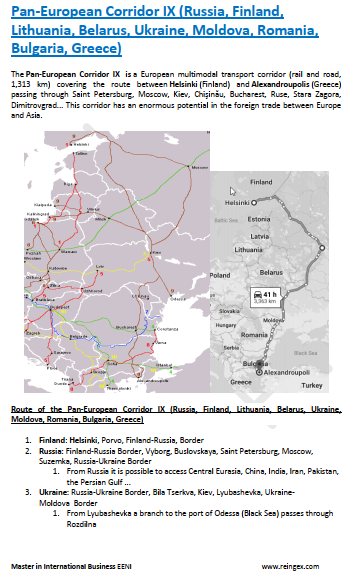
The objectives of the subject “Foreign Trade, Logistics and Business in Lithuania” are:
- To analyze the Lithuanian Economy, Logistics and Global Trade
- To conduct research on business opportunities in the Lithuanian Market
- To research the trade relations of Lithuania with the student's country
- To learn about Lithuanian free trade agreements as a member of the European Union
- To develop a business plan for the Lithuanian Market

The Subject “Foreign Trade, Logistics and Business in Lithuania” is included within the curriculum of the following academic programs at EENI Global Business School:

Masters: International Business, Foreign Trade.
Languages:  +
+  Lituania
  Lituanie
  Lituânia.
- Subject Credits “Doing Business in Lithuania”: 1

International Trade, Logistics and Business in Lithuania
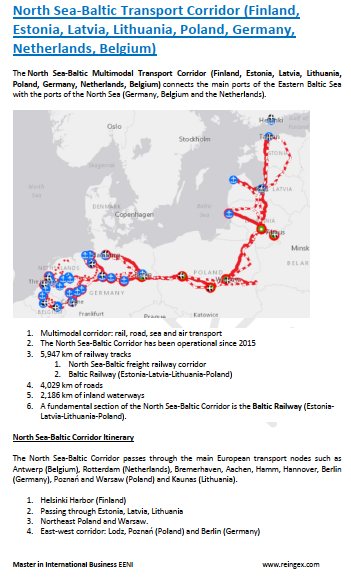
- North Sea-Baltic Corridor (Finland, Belgium)
- Pan-European Transport Corridor IX (Finland-Greece)
- Access to the:
- Pan-European Corridor II
- Trans-Siberian Railway (Russia, Mongolia, China, North Korea)
- Baltic-Adriatic Transport Corridor
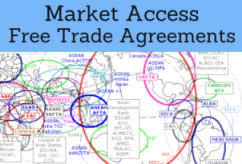
Lithuanian Preferential Access and Trade Agreements:
- Lithuania and the European Economic Area
- European Union
- European Customs Union
- European Single Market
- The European Union Services Directive
- European Digital Single Market
- As a member of EU, Lithuania is a beneficiary of EU Trade Agreements
- Council of the Baltic Sea States
- World Trade Organization (WTO)
- Agreement on Trade in Services (GATS)
- Agreement on Sanitary Measures
- Agreement on Technical Barriers to Trade
- Agreement on Preshipment Inspection
- Agreement on Safeguards
- Trade Facilitation Agreement
- World Customs Organization (WCO)
- Kyoto Convention
- Convention on the Harmonization of Frontier Controls of Goods
- CMR Convention (UN)
- COTIF Convention (Rail)
- BIC
- Chicago Convention (ICAO)
- International Maritime Organization (IMO)
- Convention for Safe Containers
- Istanbul Convention
- Customs Convention on Containers
- International Road Transport Union (IRU)
- TIR Convention
- Guidelines on Safe Load Securing for Road Transport
- Organization for Cooperation between Railways (OSJD)
- International Chamber of Commerce
- CIM / CIT Rules
European Trade and Economic Organizations of Lithuania
- Economic Commission for Europe (UNECE)
- European Union
- European Central Bank
- European Investment Bank
- European Bank for Reconstruction and Development (EBRD)
- Organization for Security and Cooperation in Europe (OSCE)
- United Nations
- World Bank
- World Trade Organization (WTO)
- International Monetary Fund
- OECD
- OECD anti-corruption measures
- Asia-Europe Meeting
- Lithuanian Capital: Vilnius
- Official Language of Lithuania: Lithuanian
- Lithuanian Area: 65,300 km²
- Lithuanian Population: 2.9 million people
- Type of Government: Parliamentary Republic
- Borders of Lithuania: Belarus, Latvia, Poland
and Russia
- Lithuania shares Maritime borders (Baltic Sea) with Sweden, Finland, Estonia, Germany and Denmark
- Independence of Lithuania: 1991 (Soviet Union)
Religion in Lithuania: Catholicism (Christianity).
Lithuania belongs to the European Economic Area.
Economy of Lithuania.
- Lithuania has a strategic role in the European Union-Russia relations
- Lithuania is a member of EU since 2004
- Lithuanian Currency: Euro
- Top Lithuanian economic activities: tourism, agricultural industries, sustainable forestry, textiles, high technology products, biotechnology, shipbuilding and laser technologies
- Lithuania ranked 24th in the world in the Index of Ease of Doing Business (WB) and 15th place (out of a total of 178 countries) in the Index of Economic Freedom (Heritage Foundation)
- Several global enterprises such as Microsoft, IBM, Transcom, Barclays, Siemens, SEB, TeliaSonera, Paroc, Philip Morris and Thermo Fisher Scientific are in Lithuania
Lithuanian Foreign Trade
- The EU is the largest trading partner of Lithuania, with 67% of total imports and 61.3% of total exports
- The Commonwealth of Independent States (CIS) is the second trading partner of Lithuania
- Main Lithuanian Exports are minerals, machinery, chemical products, textiles, foods, plastics
- Top Lithuanian exports destinations: Russia (15%), Latvia, Germany, Poland, Estonia, the Netherlands, Belarus
- Main products imported by Lithuania are minerals, machinery, transport equipment, chemical products, textiles, metals
- Main suppliers of Lithuania are Russia (32%), Germany, Poland, Latvia
- As a member of EU, Lithuania is a beneficiary of EU trade agreements with MERCOSUR, Mexico, South Korea, ASEAN, Egypt, Jordan, Lebanon, Ukraine, Moldova, Georgia...
- The Port of Klaipeda, without ice, is in the western part of Lithuania. The port is an important regional hub that connects the sea, land and Rail transport routes of the east and west
(c) EENI Global Business School (1995-2025)
Top of this page
