Business in Nigeria, Lagos, largest African Economy




 WhatsApp
Nigeria: first frontier market. 1,000 million of Nigerians in 2050. Oil, Logistics
Nigeria: The largest African Economy. The first frontier market in the World
In 2050, 20% of African children's under eighteen will live in Nigeria. Nigerian population in 2100: 1,000 million people.
Nigeria, Africa's most populous country, is a mosaic of religious and ethnic diversity, with approximately 50% Muslims (mainly in the north), 48% Christians (predominantly in the south), and 2% followers of traditional African religions. This diversity, combined with economic inequalities, ethnic rivalries, and weak governance, has made Nigeria an epicenter of religious tensions with geopolitical implications.
40% of the population are Hausa, Ibo, and Yoruba, the three major ethnic groups in Nigeria
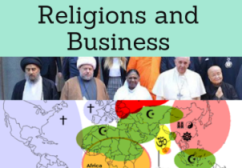
Religions and Global Business -
Religious diversity
- Introduction to the Federal Republic of Nigeria (West Africa)
- Nigerian Economy
- Main sectors of the Nigerian Economy:
- Petrol and gas
- Minerals
- Nigerian Agriculture
- Information and telecommunications
- Tourism
- Manufacturing
- Infrastructures
- International Trade of Nigeria
- Import/Export formalities
- Export processing (Free trade zones)
- Investment in Nigeria
- Transport and Logistics
- Case Study: Trade between the United States (Developed) and Nigeria (Developing)
- Case Study: Nigeria’s Trade Policy – Balancing Protectionism and Economic Integration
- Case Study
- Transnational corporation
- Nigerian breweries
- Churchgate Group
- Starcomms
- Online Nigerian retail sites
- Religious Diversity and Geopolitical Tensions in Nigeria. Boko Haram
- Access to the Nigerian Market
- Business Plan for Nigeria
International Trade and Business in Nigeria: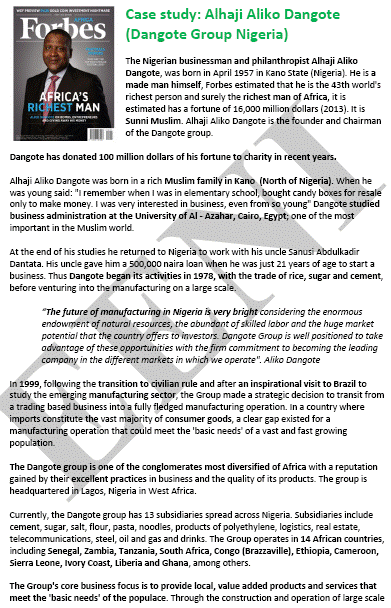
Nigerian Businessman:
- Alhaji Aliko Dangote
- Jim Ovia
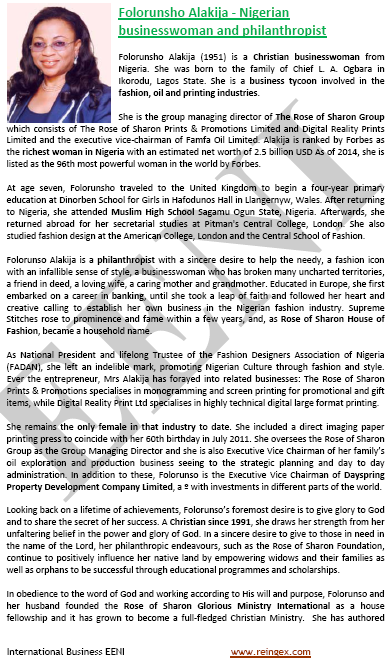
- Folorunsho Alakija
- Alhaji Indimi
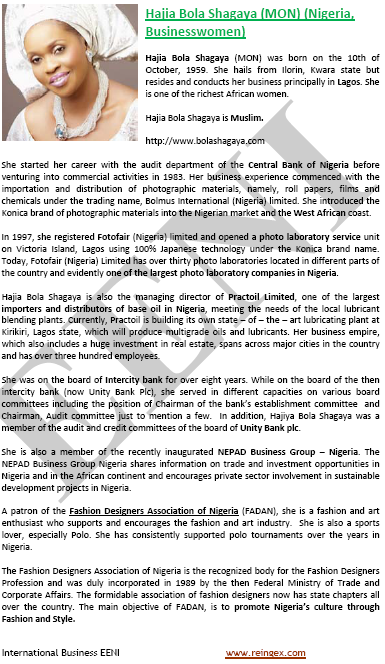
- Hajia Bola Shagaya
- Tara Fela-Durotoye
- Adenike Ogunlesi
- Folake Folarin-Coker
- Amina Odidi
- Mike Adenuga
- Tony Elumelu
- Olufemi Otedola
- Orji Uzor Kalu
- Theophilus Danjuma
- Adewale Tinubu
- Tunde Folawiyo
- Abdulsamad Rabiu
Nigerian personalities:

The educational aims of the Subject “Foreign Trade, Logistics and Business in the Federal Republic of Nigeria” are:
- To analyze the Nigerian Economy, Logistics and Global Trade
- To conduct research on business opportunities in Nigeria
- To explore the Nigerian trade relations with the student's country
- To learn about Nigerian Trade Agreements
- To examine the profile of the Nigerian Businessman
- To develop a business plan for the Nigerian Market
The Subject “Foreign Trade, Logistics and Business in Nigeria” is included within the curriculum of the following academic programs at EENI Global Business School:
Doctorate in African Business.

Master in Business in Africa, International Business.
 Masters adapted to Nigerian Students.
Languages:  or
or  Nigeria
  Nigeria
  Nigeria.
- Subject Credits “Doing Business in Nigeria”: 3

Area of Knowledge: Africa.
International Trade, Logistics and Business in Nigeria.
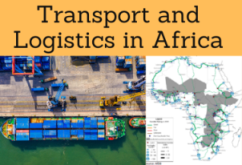
Trans-African Roads
- Algiers-Lagos Logistics Corridor
- Lagos-Mombasa Logistics Corridor
- Trans-Sahelian Highway
- N’Djamena-Djibouti Logistics Corridor
- Dakar-Lagos Logistics Corridor
Sample:
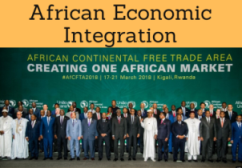
Nigerian Preferential Access and Trade Agreements:
- Nigeria and the West African Economic Area
- Economic Community of West African States (ECOWAS)
- West African Monetary Zone (WAMZ)
- Community of Sahel-Saharan States (CEN-SAD)
- African Continental Free Trade Area
- Nigeria is a beneficiary of the Africa Growth and Opportunity Act
- Africa-EU Partnership
- Islamic Trade Preferential System
- Islamic Centre for Development of Trade
- Trade Agreement with Bharat (India)
- Niger Basin Authority
- Global System of Trade Preferences among Developing Countries (GSTP)
- World Trade Organization (WTO)
- Agreement on Trade in Services (GATS)
- Agreement on Sanitary Measures
- Agreement on Technical Barriers to Trade
- Agreement on Preshipment Inspection
- Agreement on Safeguards
- Trade Facilitation Agreement
- World Customs Organization (WCO)
- Kyoto Convention
- Hamburg Rules (Maritime Transport)
- Rotterdam Rules
- ECOWAS Regional Road Transport and Transit Facilitation Programme
- BIC
- Chicago Convention (ICAO)
- International Maritime Organization (IMO)
- Convention for Safe Containers
- Istanbul Convention
- Customs Convention on Containers - not a member
- Single African Air Transport Market (SAATM / IATA)
- Economic Commission for Africa
- African Union
- AU Convention on Combating Corruption
- AUDA-NEPAD
- Africa Agriculture Development Programme
- African Development Bank
- Africa-Turkey Partnership
- Africa-Korea Partnership
- Africa-Japan Cooperation
- Africa-South America Summit
- China-Africa Cooperation
- Africa-Asia Partnership
- Africa-India Cooperation
- Africa-BRICS
- Afro-Arab Cooperation
- Arab Bank for Africa (BADEA)
- Islamic Development Bank
- Organization of Islamic Cooperation (OIC)
- Committee for Economic Cooperation
- Islamic Chamber of Commerce
- Islamic Centre for Development of Trade
- Statistical Economic Centre for Islamic Countries
- Commonwealth
- United Nations
- Conference on Trade and Development (UNCTAD)
- International Trade Centre
- Commission on International Trade Law (UNCITRAL)
- World Intellectual Property Organization (WIPO)
- World Bank
- World Trade Organization (WTO)
- International Monetary Fund
The Federal Republic of Nigeria is the most populous African Country (eleventh in the World), with a population of 190 million inhabitants (annual growth: 2.3%).
- Borders of the Federal Republic of Nigeria: Benin, Chad, Cameroon, and Niger
- The capital of Nigeria is Abuja
- The largest Nigerian city is Lagos
- The largest Nigerian cities are Port Harcourt, Kano, Ibadan, Kaduna and Maiduguri
- The total Nigerian area: 923,768 km²
- Independence of Nigeria: October 1960 from the United Kingdom
- The currency of Nigeria is the Naira
- English is the Nigerian official language
- Main Nigerian languages are HaU.S., Yoruba and Igbo (Ibo), and Fulani
More information about Nigeria (EENI African Business Portal).
Religions in Nigeria:
- Islam (50% of the Nigerian population, 64 million)
- Christianity:
- Catholicism (3 million)
- Protestants (34 million, 26% of the Nigerian population)
- Methodists: 3 million
- Baptists: 2.5 million
- African Traditional Religions
- Religious diversity and geopolitical tensions
Boko Haram, officially known as Jama'atu Ahlis Sunna Lidda'awati wal-Jihad ("Group of the People of the Sunnah for Preaching and Jihad"), is a jihadist group founded in 2002 in northeastern Nigeria, primarily in Borno State. Its rise has heightened religious and geopolitical tensions in Nigeria, a country divided between a majority Muslim north and a predominantly Christian south. Boko Haram seeks to impose a strict interpretation of Sharia (Islamic law) and rejects Western influence, particularly secular education, which has generated a devastating conflict with national and international implications.

Approximately between 64 and 88 million of Nigerians are Sunni Muslims, representing roughly the half of the Nigerian population. The most followed school of law is Maliki, about 12% of Muslims are Shiites. The rest of the population is Christian and/or followers of African Traditional Religions. As a general rule; we could say that the northern Nigeria tends to be Muslim, while the south is Christian.
In Nigeria, the Sharia has been established as the main body of civil and criminal law in nine Nigerian states with a Muslim-majority.
Nigeria belongs to the West African Economic Area.
Nigerian Economy
- Nigeria is the largest African Economy (GDP: 522 billion dollars), followed by South Africa
- Nigeria is the first frontier market in the World
- Nigeria is the dominant economy in West Africa, with more than 76.5 percent of the population and 85.6 percent of GDP of the region
- The Federal Republic of Nigeria is a petroleum-based Economy, a sector that contributes to 20 percent of GDP, 80 percent of the total revenues and 90 percent of the foreign exchange earnings
- Petroleum revenues constitute 60% of GDP and 90% of the Nigerian exports
- The Federal Republic of Nigeria is rich in natural resources (huge petrol and gas deposits, bitumen)
- Nigeria has had the unpleasant experience of political unsteadiness, corruption, and poor Macroeconomics management
- Basic socio-economic infrastructure is also unsuitable
- Nigeria is a leading petroleum manufacturer and exporter
- Nigeria is the thirteenth largest petroleum producer in the World and the eighth largest petroleum exporter
- Nigeria has one of the largest proven natural gas and petroleum reserves in the World
- Nigeria has a vast local market
- Nigeria is the most populous nation in Africa. Nigeria is the tenth largest country in the world by population
- Significant changes are taken to reform Foreign Direct Investment environment and business facilitation in the Federal Republic of Nigeria
- Nigeria has strong informal trade with Benin through the Port of Cotonou
- Nigeria is vital for the EU. The Nigerian exports to the EU are mainly agricultural products and petroleum
However, do business in Nigeria is complex, and it is necessary to know how to negotiate in this country. Furthermore, the famous fraud “419,” now called Advance Fee Fraud has made the image of Nigeria abroad very negative.
The Federal Republic of Nigeria has preferential market access to several Sub-Saharan Africa regional trade blocs.

(c) EENI Global Business School (1995-2025)
Top of this page
