
AGOA African Growth and Opportunity Act





 WhatsApp
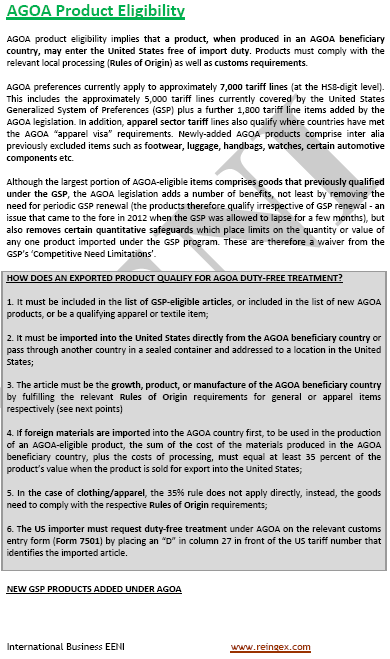
United States (AGOA V - African Growth and Opportunity Act) Product eligibility

Module: International Relations of Africa
The AGOA is a U.S. Trade Act that considerably enhances the U.S. Market Access for forty Sub-Saharan African Countries.

- Introduction to AGOA African Growth and Opportunity Act
- AGOA Amendments
- AGOA V- Extension to third country fabric preferences
- AGOA- Country eligibility
- AGOA Product eligibility
- General Rules of Origin (ROO)
- Rules of origin for Wearing Apparel
- Trade Agreements U.S.-African Countries
- Bilateral investment treaties
- Trade and Investment Framework Agreements (TIFA)
- The United States Trade with Sub-Saharan Africa
- The United States-African Countries Bilateral Trade
- Top African export Products (textiles, apparel manufacturing, coffee, and cashew)
- Exports by product sector
- Apparel Trade under AGOA. Trade Quotas
- Specialized projects
- West Africa Trade Hub
- Sub-Saharan African Suppliers to the United States
- The United States Direct Investment in Africa. Successes cases
- African global competitiveness initiative and African trade hubs
- East and Central Africa Trade Hub
- Southern Africa Global Competitiveness Hub
- Case Study: Handcrafts export growth in Ghana. Senegalese exporters. African Growers at the Super Floral Show in Atlanta
- Historical evolution of Foreign Trade between the United States and Africa under the AGOA

The educational aims of the Subject “African Growth and Opportunity Act (AGOA)” are:
- To understand the purposes of AGOA
- To evaluate the admission criteria by country and product eligibility
- To understand general rules of origin for textiles under AGOA
- To analyze the access to the United States market for African products under AGOA
- To knowe Trade Agreements between African Countries and the United States (COMESA, UEMOA, EAC)
- To analyze International Trade between African Countries and the United States

The Subject “African Growth and Opportunity Act (AGOA)” is included within the curriculum of the following academic programs at EENI Global Business School:
Doctorate in African Business.


Languages:  or
or  Loi sur la croissance et les possibilités économiques en Afrique (AGOA)
  Lei de Crescimento e Oportunidades para a África (AGOA)
  Ley de Crecimiento y Oportunidad en África (AGOA).
- Subject Credits “African Growth and Opportunity Act (AGOA)”: 1

African Growth and Opportunity Act (AGOA).
eligible countries for the AGOA are Angola, Benin, Botswana, Burkina Faso, Burundi, Cameroon, Cape Verde, Chad, Comoros, Democratic Republic of the Congo, Djibouti, Eswatini, Ethiopia, Gabon, Gambia, Ghana, Guinea, Guinea-Bissau, Ivory Coast, Kenya, Lesotho, Liberia, Madagascar, Malawi, Mali, Mauritania, Mauritius, Mozambique, Namibia, Niger, Nigeria, Republic of the Congo, Rwanda, São Tomé, Senegal, Seychelles, Sierra Leone, South Africa, Tanzania, Togo, Uganda, and Zambia.
not eligible countries for the AGOA are Zimbabwe and Sudan.
The AGOA passed as a part of the Trade and Development Act (2000) provides to the beneficiary countries in Sub-Saharan Africa with the most liberal access to the United States Market available to any nation or region with which the United States do not have a Free Trade Agreement.
The AGOA strengthen African reform efforts, provides an improved access to the United States, credit, and technical expertise, and create a high-level dialogue on Foreign Trade and Foreign Direct Investment (FDI) in the form of a United States-Sub-Saharan Africa Trade and Economic Forum.
The Africa Investment Incentive Act (2006) amends parts of the AGOA and is referred to as “AGOA IV.” The AGOA extends GSP (Generalized System of Preferences) for eligible Sub-Saharan African beneficiaries.
Sample - African Growth and Opportunity Act (AGOA):
United States-Africa Trade.
Since its beginning in 2000, the AGOA has contributed to the increasing of Foreign Trade with Africa and diversify the range of exported products.
- Total International Trade between the United States and Sub-Saharan Africa augmented 37% (USD 60.6 billion)
- The United States total exports to Africa reach 22% to USD 10.3 billion, with outstanding gains in the agricultural products, machinery, and international transport equipment
- The United States total imports (AGOA and non-AGOA) from Africa augmented by 40% to USD 50.3 billion, mostly owing to an increase in the petrol imports
- The United States imports from the Sub-Saharan African Countries under the AGOA (including its GSP dispositions) were USD 38 billion
- Non-petrol AGOA trade decreased by 16%, to USD 2.9 billion. Principally owing to declines in the AGOA apparel imports (USD 1.4 billion, down 12%), minerals and metals (USD 493 million, down 32%), and transport equipment (USD 273 million, down 49%)
Bilateral investment treaty (US-African Countries): Rwanda, Mozambique, the Republic of the Congo, the DR Congo, and Cameroon.
Trade and Investment Framework Agreements (TIFA): Angola, Ghana, Liberia, Mauritius, Mozambique, Nigeria, Rwanda, South Africa, the Common Market for Eastern and Southern Africa (COMESA), the East African Community (EAC), and the West African Economic and Monetary Union (WAEMU).
(c) EENI Global Business School (1995-2025)
Top of this page
