Business in Ghana - African Frontier Market






 WhatsApp
Ghana: second African gold producer. Ghanaian Foreign Trade. Tema, Takoradi, Accra

Ghana is one of the world's leading gold producers. Many multinational companies invest in mining projects. However, in various mining communities, traditional religions play a key role in the acceptance or rejection of these projects.
Ghana: an African Frontier Market and the second gold producer in Africa.
Foreign Direct Investment Centre in West Africa.
- Ghana is a Middle-income country (ODA)
- Ghana is an African Frontier market
- Ghana is the second African gold producer

- Introduction to the Republic of Ghana (West Africa)
- Regions of Ghana
- Albert Adu Boahen Kwadwo (Ghanaian Historian)
- James Emman Kwegyir Aggrey was born in Ghana (“If you educate a woman, you educate a whole nation”)
- Economy of Ghana
- Foreign Trade of Ghana
- Ghanaian Customs:
- Importing to Ghana
- Exporting from Ghana
- Ghanaian Customs:
- Business and Investment Opportunities in Ghana
- Transport and Logistics
- Case Study:
- Business Opportunities in the agriculture sector
- Kasapreko Company
- Access to the Market
- Business Plan for Ghana
- Case Study: Gold Mining in Ghana and the Influence of African Traditional Religions
Sample:

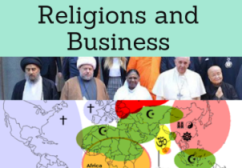
Religions and Global Business -
Religious diversity
The educational aims of the Subject “Foreign Trade, Logistics and Business in Ghana” are:
- To analyze the Ghanaian Economy, Logistics and Global Trade
- To conduct research on business opportunities in Ghana
- To explore the Ghanaian trade relations with the student's country
- To learn about Ghanaian Trade Agreements
- To examine the profile of Ghanaian companies
- To develop a business plan for the Ghanaian Market

The Subject “Foreign Trade, Logistics and Business in Ghana” is included within the curriculum of the following academic programs at EENI Global Business School:
Master in Business in Africa, International Business.

Doctorate in African Business.

Masters adapted to  Ghanaian Students.
Languages:  or
or  Ghana
Ghana  Gana
Gana  Ghana.
- Subject Credits “Doing Business in Ghana”: 2

EENI Principle of Racial Harmony.
International Trade, Logistics and Business in Ghana.
Ghanaian Preferential Access and Trade Agreements:
- Ghana and the West African Economic Area
- West African Monetary Zone (WAMZ)
- African Continental Free Trade Area
- Economic Community of West African States (ECOWAS)
- ECOWAS Regional Road Transport and Transit Facilitation Programme
- Community of Sahel-Saharan States (CEN-SAD)
- UK-Ghana Agreement
- Ghana-EU:
- Africa-EU Partnership
- GSP
- AGOA
- Global System of Trade Preferences
- Trade Agreement with India
- World Trade Organization (WTO)
- Agreement on Trade in Services (GATS)
- Trade Facilitation Agreement
- Agreement on Sanitary Measures
- Agreement on Technical Barriers to Trade
- Agreement on Preshipment Inspection
- Agreement on Safeguards
- World Customs Organization (WCO)
- Kyoto Convention
- International Maritime Organization
- Istanbul Convention
- Customs Convention on Containers - not a member
- Hamburg Rules (Sea)
- Rotterdam Rules
- Economic Commission for Africa
- African Union
- AU Convention on Combating Corruption
- AUDA-NEPAD
- Africa Agriculture Development Programme
- African Development Bank
- Africa-India Cooperation
- Africa-BRICS
- Africa-Turkey Partnership
- Afro-Arab Cooperation
- Arab Bank for Africa (BADEA)
- Africa-Asia Partnership
- Africa-Korea Partnership
- Africa-Japan Cooperation
- Africa-South America Summit
- China-Africa Cooperation
- United Nations
- Conference on Trade and Development (UNCTAD)
- International Trade Centre
- World Intellectual Property Organization (WIPO)
- World Bank
- World Trade Organization (WTO)
- International Monetary Fund
Ghana is an observer country of the International Organization of the Francophonie.
- Official language of the Republic of Ghana: English. 100 local languages
- Ghanaian Capital: Accra
- Borders of Ghana: Burkina Faso, Ivory Coast, and Togo
- Ghanaian Area: 238,535 km²
- Population of Ghana: 29 million people
- Regions of Ghana: Greater Accra, Ashanti, Brong Ahafo, Central Region, Eastern Region, Northern Region, Upper East, Upper West, Volta Region, and Western Region
- Kofi Annan (former Secretary-General of the UN) was born in 1938 in Ghana

More information about Ghana (EENI African Business Portal).
Main Religions in Ghana:
- Christians (63%
of the Ghanaian population)
- 7 million Protestants
- African Traditional Religions
- Muslims (20%)
Ghana belongs to the West African Economic Area.
Economy of Ghana:
- The Service-oriented sector is the most dynamic of the Ghanaian economy (50% of GDP)
- Ghanaian petroleum sector. Petroleum reserves: 2.0 billion barrels. 22% of the total value of exports
- Ghanaian Industry: 27% of GDP
- Vigorous economic growth (6% over the past six years), mainly due to the petrol and petroleum production
- Agriculture: 20% of GDP. Crop production: 16% of GDP
- Free Export Zone
- Greater Accra region: 15% of the Ghanaian population
- Ashanti region: Cocoa and gold mining industry
- Ghanaian currency: Ghana Cedi
- Ghana has a universal health system
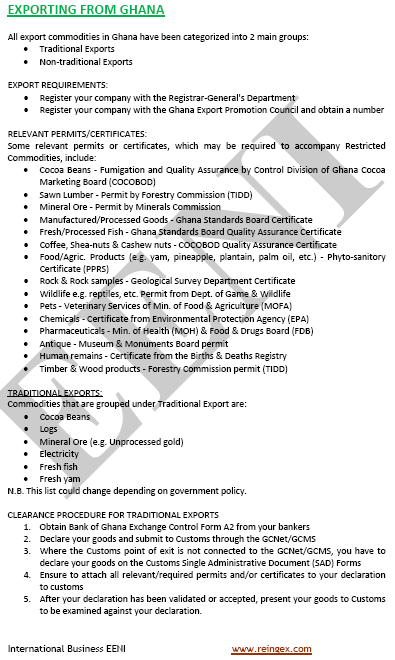
Sample - Exporting from Ghana:
(c) EENI Global Business School (1995-2025)
Top of this page
