Corruption and Corporate Social Responsibility










 WhatsApp
Philanthropy and enterprises with Social Responsibility. Sustainability Index

Religions and Global Business -
Religious diversity
Corporate Social Responsibility (CSR) transmits the vision of a company towards society and environment. If the society has allowed the company to develop its business, the company, in some way, is indebted to society, beyond the existing legal requirements.
Corporate Social Responsibility transmits the ethical principles and values of the company. The fight against corruption and the human rights defense must be part of a company's Social Responsibility.
Religious values often guide corporate social responsibility (CSR). Buddhist principles of compassion influence companies in Thailand and Sri Lanka to prioritize environmental sustainability. Similarly, Christian companies like Hobby Lobby prioritize family-friendly policies, supported by 65% of American consumers who prefer brands with an ethical vision (Nielsen, 2024).
- Introduction to the Corporate Social Responsibility (CSR)
- Initiatives: Global Report and InFocus (International Labour Organization)
- Dow Jones Sustainability Index
- Corporate Social Responsibility and the European Union
- Religions and Corporate Social Responsibility
Sample - Corporate Social Responsibility

The Subject “Corporate Social Responsibility” is included within the curriculum of the following academic programs at EENI Global Business School:
All the Masters in International Business.
Doctorate in International Business.
Module: No to Corruption in International Business.
Languages:  (or
(or  Responsabilidad Social
  Responsabilité sociale).
“Businesses have a profound social responsibility that should be shown every day, not only through the ethical business practices, fair and environmentally sustainable in all the aspects of an Organization, but also an active participation in the fundamental issues of society” Azim Premji (he had donated more than 25 percent of his fortune to charity).
“Starting a business is one of the greatest acts of social responsibility. Creating enterprises, create work” Luis Carlos Sarmiento
Religions often promote ethical principles such as justice, solidarity, respect for life, and responsibility toward the community and the environment. These values align with the pillars of Corporate Social Responsibility (CSR), which encompass the social, environmental, and economic impact of companies.
Many enterprises apply the Corporate Social Responsibility as a mere declaration of intent (“because it is fashionable”), others because they are convinced to give back to the society part of what it has given, and there are others, not many, which are including the Corporate Social Responsibility as a fundamental part of their business strategy, directly influencing on its product/service development and/or the price strategy.
“I do not want to make money with these diseases that are causing so much damage to society.” Yusuf Hamied (AIDS drugs of low cost).
The Indian enterprises are leading this change, as it will be analyzed in the case studies of the Indian Businesspeople (Cyrus S. Poonawalla, Tata Group...) These enterprises are designing products and services totally based on the vision of corporate social responsibility, which is closely related to the ethical principles of Hinduism, Jainism, Sikhism, or Islam (Zakat is one of the five pillars of Islam).
The investment strategy of Sheikh Mohamed Bin Issa (Saudi Arabia) is an excellent example of social responsibility application.
Under this point of view, the Corporate Social Responsibility can be seen in other markets, especially in the Asian or the Muslim Countries, more like a Western fashion than as a true attitude of the enterprise to society.
It is also important to note the philanthropic work that many enterprises and businessman are undertaking as a part of their Corporate Social Responsibility.
“Business is not just about revenues and profits, but also to help keep our earth green, our communities healthy and help children to be smart.” Adi Godrej (25% of the shares of the Godrej Group are engaged in philanthropy.
Either way; it is necessary to recognise the role that develops those businessmen who apply Corporate Social Responsibility.
EENI wishes to pay tribute to several business men and women around the world who are spending huge sums in philanthropic activities: Carlos Slim, Sahu Jain, Gautam Adani, Bhavarlal Jain, Hinduja Group, Birla, Mukesh Ambani, Kiran Mazumdar, Kith Meng, Kazuo Inamori, Jyoti, Lee Kun-hee, Zhang Ruimin, Chang Yung-fa, Yelena Baturina, Alexander Lebedev, Onsi Sawiris, Bin Talal, Mohamed Ibrahim, Mohammed Al-Amoudi, Abdul Aziz Ghurair, Nasser Al Kharafi, Muhammad Yunus, Mian Muhammad Mansha, Salman F Rahman, Dewan Farooqui, Sandiaga Salahuddin Uno, Tarek Talaat Moustafa, Hassan Abdalla, Mohamed Mansour, Osama Abdul Latif, Mohamed Ali Harrath, Othman Benjelloun.
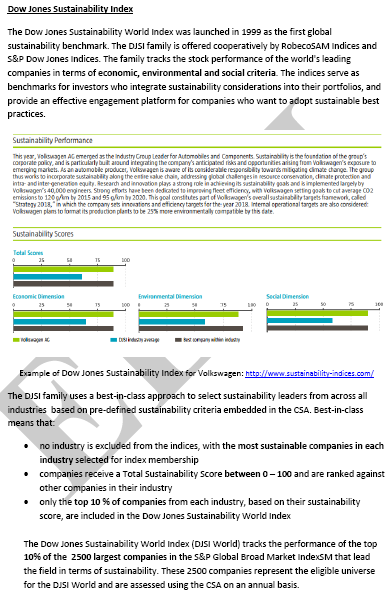
The Dow Jones Sustainability Index
The Dow Jones sustainability index were created in 1999 as the first Global sustainability indicator. These indexes show the performance of the shares of the leading enterprises in the World regarding the economic, environmental, and social criteria.
Note: The objective of this Subject is not to analyze in depth the Corporate Social Responsibility, whose objectives would be away from the global vision of the project “Ethics, Religion and International Business,” but provide a brief introduction to the CSR.
(c) EENI Global Business School (1995-2025)
Top of this page
