
Export-Import, International Trade, Exporting







 WhatsApp
Export process. Nature of exporting. Problems from Non-Internationalization

Exporting is the practice of marketing and selling domestically produced goods or services to foreign customers. It represents one of the most widely used and accessible entry strategies for companies expanding into international markets
- Introduction to Exporting
- Advantages of exporting
- Resources Needed for exporting
- Starting the Export Activity
- Export Process
- Trade Restrictions
- Tariffs and Quotas
- Problems deriving from Non-Internationalization
- Introduction to Foreign Direct Investment
- Case Study: Exporting Solar Panels from China to Germany
- Case Study: Digitizing Solar Panel Exports from China to Germany with TradeLens and eTradeHub
- AI and Global Trade
- Digital Trade and Cross-Border E-Commerce
- AI in Global Strategy and Decision-Making
- AI in Global Supply Chain Management
The educational aims of the Subject “Introduction to Exporting” are the following:
- To understand the nature of exporting and difficulties that may arise
- To learn about import and export transactions, the difficulties with them and how to overcome these challenges
- To analyze advantages of exporting and risks of non-exporting
This will be achieved by:
- Examining the fundamental questions related to the export process
- Analyzing the challenges to overcome in an export transaction
- Detailing the steps necessary to beginning the export process
The Subject “Introduction to Exporting” is included within the curriculum of the following academic programs at EENI Global Business School:
Masters: International Business, Foreign Trade.

Postgraduate Certificate in International Trade.

Languages:  or
or  Exportación
  Exportation
  Exportaçao.
Credits of the Subject “Introduction to Exporting”: 1 ECTS.

IMPORTANT NOTE: This subject is only an introduction to exporting. The student will have a real vision on Foreign Trade, after studying the following subjects:
Exporting can no longer be considered as just selling Products/services from one country into another. Rather, it is a:
“Dynamic business whereby the export company ensures products/services it exports to reach the customer in a condition to fully satisfy the needs of the latter in the expectation of getting repeat business.”
This dynamic nature means that the company wishing to export cannot be satisfied with just passively placing its stocks or certain amounts of products in foreign markets
When to Use Exporting as a Market Entry Strategy
- Excess Production Capacity: When your business has unused production resources that can be leveraged to serve foreign markets
- Low-Risk Market Testing: When you want to explore the potential of a foreign market with minimal financial and operational risk
- High International Demand: When there is strong demand abroad for your Product or service
- Limited Investment Requirements: When you aim to expand into new markets without committing to large-scale Investment such as setting up local operations or facilities.
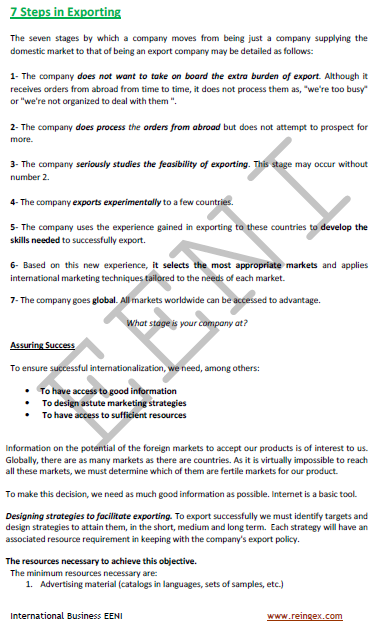
Starting export activity
There are many ways a company may choose to enter international markets. Participating in an International Trade fair held in one's country is a common starting point. At these fairs; it is the foreign visitors who come to investigate our products rather than we approach them; this is known as passive exporting.
For certain firms, they may have started at the outset as international enterprises in the sense that their mission is to be involved in International Business activities. For many others, however, they may have begun as national firms concentrating on their local markets before shifting or expanding the focus also to cover international markets. It is thus useful to investigate the stages of internationalization.
(c) EENI Global Business School (1995-2025)
Top of this page
