
Maritime Transport in Africa, Ports, Lagos





 WhatsApp
Ports of Durban, Abidjan, Douala, Mombasa, Dar es-Salaam, Lagos (Logistics)
Transport and Logistics in Africa
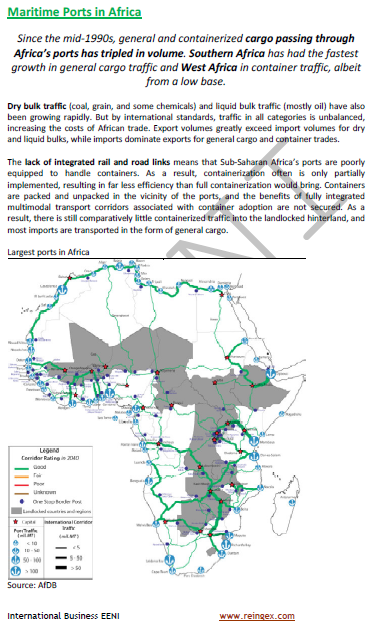
Foreign Trade traffic through the Africans ports has tripled in the last decade.
Importance of African corridors for landlocked countries

1- Introduction to Maritime Transport in Africa
- Revised African Maritime Transport Charter
- Durban Resolution on Maritime Safety, Maritime Security and Protection of Marine Environment in Africa
2- Largest African Ports.
3- Maghrebian Ports.
4- Egyptian ports.
- Port Said and Port of Alexandria
- Suez Canal
- Port of Abidjan (Ivory Coast)
- Ports of Tema and Takoradi (Ghana)
- Port of Lagos (Nigeria)
- Port of Dakar (Senegal)
- Port of Lomé (Togo)
- Port of Cotonou (Benin)
- Maritime Organization for West and Central Africa (MOWCA)
- Port of Luanda and Port of Lobito (Angola)
- Port of Douala (Cameroon)
- Port of Pointe Noire (Congo)
- Ports of Gabon
- Ports of Equatorial Guinea: Malabo, Bata, and Luba Freeport
- Maritime Organization for West and Central Africa
- Ports of Beira, Nacala and Maputo (Mozambique)
- Port of Djibouti
- Port of Mombasa (Kenya)
- Port Sudan
- Port of Dar es-Salaam (Tanzania)
- Ports of Madagascar
- Port of Durban (South Africa)
- Other South African Ports: Richards Bay, East London, Ngqura, Port Elizabeth, Mossel Bay, Cape Town, Saldanha
- Port of Walvis Bay (Namibia)
Sample - Maritime Transport in Africa:

The educational aims of the Subject “Maritime Transport in Africa” are:
- To learn about state of African maritime transport
- To analyze the features of the largest African ports
- To know how to access the fifteen African landlocked countries through transport corridors and ports
- To evaluate disconnection between rail and road transport networks and African ports
- To analyze the difficulty of Containerization, bottlenecks and high port costs in Africa

The Subject “Maritime Transport in Africa” is included within the curriculum of the following academic programs at EENI Global Business School:
Logistics Courses: International Transport, Maritime Transport, Multimodal.
Master in Business in Africa, International Transport, Transport and Logistics in Africa.
Doctorate in African Business, Global Logistics.

Languages:  or
or  Afrique Transport Maritime. Summaries in
  África Transporte Maritimo
  Africa Transporte Maritimo.
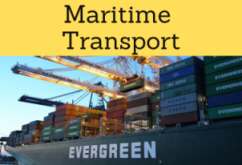
Maritime Transport in Africa.
- Port Deregulations
- In general, high port tariffs. Increase of logistics costs
- Many African Ports are inadequately equipped to handle containers
- Lack of integrated road and Rail transport links
- Bottlenecks in many African Ports
- Need for investments and institutional reforms. Chinese investments
- Fastest growing region by general cargo: Southern Africa
- Fastest growing region by container traffic: West Africa
- The largest African port: Port of Durban
Sample: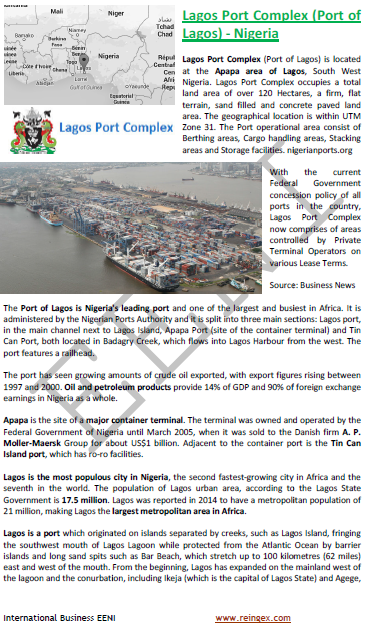
(c) EENI Global Business School (1995-2025)
Top of this page
