
Port of Lobito (Angola) Benguela Railway






 WhatsApp
Access to DR Congo, Zambia, Zimbabwe via Port of Lobito (Angola)
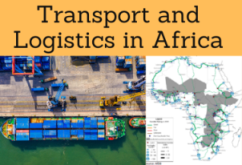
Logistics in Africa, Maritime Transport in Africa, Central African Ports
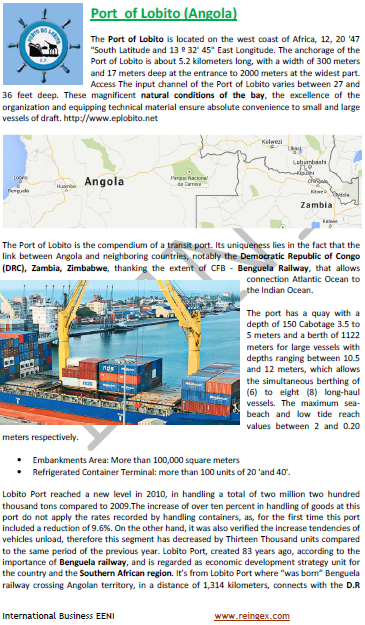
The Port of Lobito is the second port of Angola (the largest is the Port of Luanda).
- Location of the Port of Lobito: Atlantic Coast (Central Africa)
- Benguela Railway (links Atlantic with the Indian Ocean)

Access to the Democratic Republic of the Congo, Zambia, and Zimbabwe

- Introduction to the Port of Lobito (Angola)
- Main features of the Port of Lobito
- Access to Zimbabwe, Zambia, and the DR Congo
- Benguela Railway
Port of Lobito

The Subject “Port of Lobito (Angola)” is included within the curriculum of the following academic programs at EENI Global Business School:
Logistics Course: Maritime Transport.
Masters: Transport in Africa, Business in Africa.

Doctorate in African Business, Global Logistics.

Masters adapted to
 Zambia, and
  Zimbabwe.
Languages:  or
or  Port de Lobito
  Porto de Lobito. Summary in
  Puerto de Lobito.
- Refrigerated Container Terminal in the Port of Lobito
- Deep port (17 meters)
- Since 2008, expansion project of the Port of Lobito
- Container Terminal for minerals
- Terminal ores
- Berthing pier
- Distance from the Port of Lobito to (in miles)
- New York: 7,537
- Cape Town: 1,410
- Amsterdam: 5,127 - Main cities near the Port of Lobito are Lobito, Benguela, Huambo, Lubango, Silva Porto, Camacupa, Menonge, Cuvelai, Namacunde, Lubango, and Luanda

Benguela Railway (Caminho de Ferro de Benguela), Rail Transport in Africa.
- Links the Angolan Port of Lobito with Luau
- Reopened in 2014 with Chinese investments (2 billion dollars)
- At the Angolan border, ties with the Katanga Railway (access to the RD Congo and Zambia)
- Max. Speed: 90 kilometers/h
- Main cities:
- Angola: Benguela - Cubal - Huambo -Kuito - Munhango - Luena - Luau
- Democratic Republic of the Congo: Lubumbashi-Ndola
More information about Angola (EENI African Business Portal).
The Port of Lobito belongs to the Central African Economic Area.
African Regional Economic Communities:
- Economic Community of Central African States (ECCAS)
- Southern African Development Community (SADC)
- COMESA-EAC-SADC Agreement
Trans-African Roads (Logistics Corridors) related to the Port of Lobito:
(c) EENI Global Business School (1995-2025)
Top of this page
