Why study Taoism, Confucianism and Business?






 WhatsApp
Taoism, Confucianism, Ethics, Business (Course / Master / Doctorate)
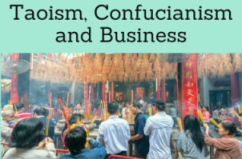
Taoism, Confucianism & Business

Related Doctorate, Masters and Courses offered by EENI Global Business School:
Masters: International Business, Religions and Business.
Doctorate: Global Ethics, Religions, and International Business, World Trade.

Why study the course “Taoism, Confucianism, Ethics and Business”?

This online educational program is aimed at executives and enterprises wishing to do business in China (a BRICS Country, the largest market in the world), a market where the influence of Taoism and Confucianism (as well as Buddhism) is fundamental.
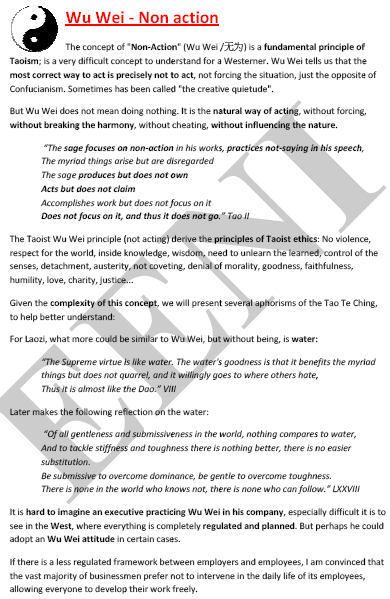
Taoism and Confucianism, Yin and Yang, responsibility and freedom, represent the two poles of Chinese society; like the Yin and Yang, Confucianism would not exist without Taoism, and vice versa.
These two traditions of wisdom, along with Buddhism and Shamanism are part of Sinic Civilization and its entire area of influence: the Sinic Economic Area (China, South Korea, Hong Kong, Japan, Macao, Singapore, Taiwan and Vietnam).
Note: the analysis of Buddhism is not done in this course, but in the course on Buddhism.
Knowing the pillars of Confucian Ethics and Taoist Ethics will be essential to understand their influence on business, culture and even in relations between the countries in the Sinic Economic Area, as with relations with other economic areas. GUANXI, based on Confucianism, is fundamental to understand the importance of personal relationships in China.
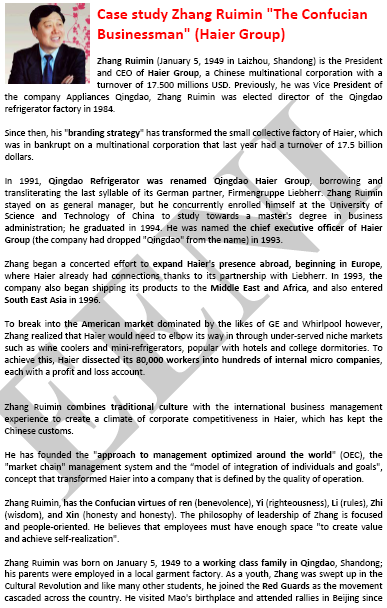
Chinese multinationals (HAIER, COSCO, Galanz, Huawei, Chint...) have become key players in the world economy, being present in the five continents and controlling important enterprises around the world. 70% of the toys in the world, 40% of the microwaves, 20% of the refrigerators, 25% of the washing machines or 30% of the air conditioners are manufactured by the Chinese enterprises. The Pearl River Delta Economic Zone, with 53,000 factories, is the largest exporting and importing region in China, thanks to the Closer Economic Partnership Agreement (CEPA) with Hong Kong.
To better understand Chinese business idiosyncrasy, student will analyze the profile of several Chinese enterprises and entrepreneurs, where the influence of Confucianism and Taoism on their business strategy and corporate social responsibility policies. The profiles of Zhang Ruimin (president of the Haier Group, Confucian) or Chang Yung-fa (Director of Evergreen, Taiwan) practising the I-Kuan Tao religion (with elements of Taoism, Confucianism and Buddhism) will be analyzed.
Therefore, this course is also recommended for anyone who wants to do business with Chinese enterprises from anywhere in the world or who wants to work in a company of a Chinese origin.
The course is also aimed at all those who wish to do business in the markets of Sinic Economic Area: China, South Korea, Hong Kong, Japan, Macau, Singapore, Taiwan and Vietnam.

The Economic Organizations and Trade Agreements between the countries of Sinic Economic Area will also be analyzed.
- Intra-Sinic Trade Agreements: China-Singapore, Korea-Singapore, Japan-Singapore...
- Relations with ASEAN
- China-ASEAN Agreement
- ASEAN-South Korea Free Trade Area
- ASEAN-Japan Economic Partnership Agreement
Sample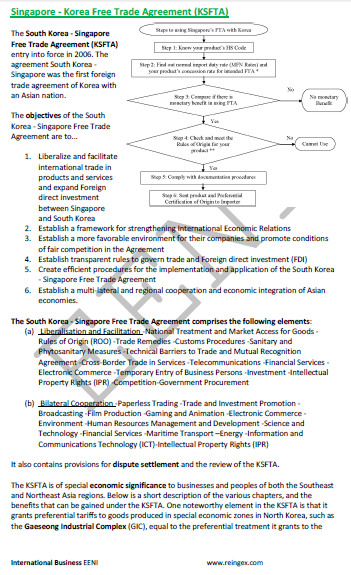
As well as, the interactions with other economic areas:
- Economic organizations: APEC, Asia-Pacific Trade Agreement (APTA), Organization for Cooperation between Railways (OSJD), Greater Mekong Subregion, Trans-Pacific Economic Partnership Agreement (CPTPP)..
- Trade Agreements:
- China has trade agreements with Pakistan, Chile, New Zealand, Peru, Costa Rica, the EU, Andean Community..
- South Korea has trade agreements with EFTA, the United States, Singapore, ASEAN-South Korea Free Trade Area, the EU, India, Peru, Chile, SACU..
- Japan has trade agreements with Mexico, Chile, Thailand, Brunei, Vietnam, Switzerland, Indonesia...
- Singapore has trade agreements with Australia, China, Jordan, India, New Zealand, Panama, Peru, EFTA, the United States..
- Taiwan has trade agreements with Panama, Guatemala, Honduras-El Salvador, and Nicaragua...
The strong influence of China in Africa (the Sinization of Africa, control of raw materials), and the increasing the role of Korea and Japan in the African continent will also be analyzed.
- China-Africa Cooperation: a key political-trade tool for the Sinization of Africa
- Africa-BRICS Countries (China is one of the BRICS Countries)
- Africa-Korea Partnership
- Tokyo International Conference on African Development (Japan)
Why study Religions and Business?.
 Religiones
de China
Religiones
de China  Religions de la Chine
  Religiões da China.
(c) EENI Global Business School (1995-2025)
Top of this page
